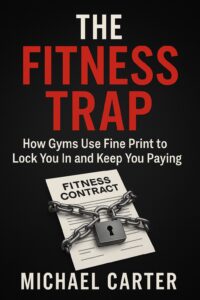
The Fitness Trap
The Truth About Memberships, by Michael Carter
Carter writes as a consumer and a veteran, not as a lawyer. The book is clearly labeled as commentary and opinion, and it is written so ordinary readers can recognize the fine print before it costs them.
What The Fitness Trap Covers
The book moves in nine short chapters and an epilogue, from the bigger financial picture down to the contract in your hand, and then out again to what needs to change.
- Chapter 1, The Cost Trap: why families who earn more than ever still feel poorer, and how the gym contract fits into that larger squeeze.
- Chapter 2, The Illusion of Easy Gains: how ads sell health, belonging, and a “family gym” feeling, while the fine print tells a different story.
- Chapter 3, Edge of Deception: the story that started the book, a 19-year-old caught in an Edge Fitness contract signed with a few taps on his phone.
- Chapter 4, The Arbitration Wall: how arbitration clauses keep consumer disputes out of court and out of public view.
- Chapter 5, The Debt Workout: the real math behind “only $25 a month.”
- Chapter 6, Stories from the Trenches: members who kept paying long after they stopped going.
- Chapter 7, Breaking Free: practical ways consumers can push back.
- Chapter 8, Toward Honest Fitness: proof that fair gyms exist.
- Chapter 9, A Call for Reform: five changes that would protect members.
- Epilogue, The Real Cost of Health: why honest business is still good business.
The Story Behind The Fitness Trap
The book began with a friend Carter has known since his military days. Through deployments and hard years, Carter had never seen him so shaken. His 19-year-old son had joined Edge Fitness on impulse, with no paper contract and no signature, just a few taps on a smartphone. He went to the gym twice in two months and realized it was not what he had been sold.
Leaving was another matter. As Carter describes it, the rules allowed cancellation only with documented relocation, a certified medical reason, or arbitration, and the payments kept coming. “How can they do this?” his friend asked. The book is Carter’s answer.
For more on Edge Fitness and what the book says about its contracts, read The Fitness Trap: Edge Fitness Memberships.
Real People, Real Bills
Carter’s point is that these are not rare cases. In Chapters 5 and 6 he tells the stories of members like:
- Maria, the parent, who joined with her teenage daughter, stopped going after two months when life got busy, and was told her reasons for canceling weren’t valid. She paid almost $700 over the year.
- Ethan, the student, who clicked a link he thought was a trial and found himself in a 24-month contract. He went three times and paid about $700 on a part-time income.
- Anthony, the worker, a father of three who joined in January, was working overtime by March, and was laid off soon after. He was told there were no cancellations without relocation proof.
The pattern, Carter writes, is the plan: sell hope with glossy ads, secure revenue with contracts, and make leaving harder than staying.
The Math Behind “Only $25 a Month”
Chapter 5 shows how a low monthly price adds up. In Carter’s example, a month-to-month plan runs about $370 a year once fees are included, a 12-month prepaid plan costs about $350 up front with no refunds, and a 24-month “value plan” locks in $700 or more. If you stop going, the charges keep rolling. As Carter puts it, the real workout happens in your wallet.
The Arbitration Wall
Many gym contracts include an arbitration clause. In Carter’s view, that clause means no lawsuit, no class action, limited evidence, and a process that tends to favor the company that uses it again and again. The book points to real reference points, including the FTC’s 2025 lawsuit against LA Fitness over cancellations it called “exceedingly difficult,” Consumer Reports’ 2023 criticism of forced arbitration, CFPB findings on how rarely consumers file arbitration claims, and the Supreme Court’s 2011 decision in AT&T Mobility v. Concepcion.
Carter also explains a quieter cost. Court cases create public records that warn the next customer. Private arbitration does not. That silence, he argues, is not innocence. It is why consumer stories matter so much.
Breaking Free: Turning the Trap Around
According to Carter, gyms that rely on fine print count on three things: inertia (you won’t fight), ignorance (you don’t know your rights), and intimidation (legal language will scare you off). His answer is to flip all three:
- Document everything. Keep records of your signup, every payment, and every cancellation attempt.
- Escalate relentlessly. Every call, email, and certified letter raises the cost of ignoring you.
- Use visibility. Honest public reviews and complaints carry weight with a company that markets itself as “family-friendly.”
- Bring in regulators. File complaints with the FTC, your state attorney general, or a consumer protection office.
The FTC explains how auto-renewing memberships and subscriptions work, and how to get out of them, in its guide to free trials, auto-renewals, and subscriptions. Before you sign anything, use the contract checklist on The Fitness Trap: Gym Contracts Exposed.
Not Every Gym Is a Trap
This is not an anti-gym book. In Chapter 8, Carter remembers his family’s membership at a renovated YMCA as a safe, welcoming place to belong. He also writes that he joined and canceled Planet Fitness four different times, each without penalty or hostility. Those experiences, he says, prove fairness in the fitness industry is possible. A good gym follows the most basic rule of commerce: if a customer is unhappy, let them walk away.
Five Reforms the Book Calls For
- Ban forced arbitration in consumer contracts, so arbitration is an option and not a requirement.
- Require clear cancellation online, in person, or by mail, with no penalty. A gym should never be harder to leave than to join.
- Give prorated refunds on prepaid memberships when a member leaves early.
- Write contracts in plain English, one page or less.
- Require gyms to publish yearly reports on cancellations, disputes, and complaints.
In the epilogue, Carter is clear that he is not trying to put anyone out of business. A gym does not need to deceive to profit. It needs to give people what they paid for.
Who Should Read The Fitness Trap
- Anyone about to sign a gym or fitness studio agreement.
- Parents whose teens or college students are joining for the first time.
- Military families and others who relocate often.
- Anyone who has tried to cancel and been told “no.”
Frequently Asked Questions
Is The Fitness Trap legal advice?
No. The book is commentary and opinion written for education. For help with your own contract, talk to a qualified professional.
Does the book say all gyms are bad?
No. It praises fair, honest gyms, and it names the YMCA and Planet Fitness as good experiences in Carter’s own life.
Where can I buy it?
The Fitness Trap is available on Amazon. For bulk copies or interviews, use the Contact Michael Carter page.
More From Michael Carter
The Fitness Trap opens with the same pressure Carter explores in When Companies Get Richer and Workers Get Less. Readers who like his direct style may also enjoy Insanity Checked In, Humanity Checked Out and Is It a Sin to Be Rich? See every title on the Books page.