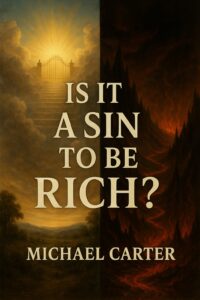
Is It a Sin to Be Rich?
Is It a Sin to Be Rich? asks a question that has followed believers for thousands of years. Scripture blesses the poor and warns that it is easier for a camel to pass through the eye of a needle than for a rich man to enter the kingdom of God. However, power and wealth have almost always stayed in the hands of the few. Michael Carter follows that contradiction through history and asks a harder question: did religion lift up poverty to empower the poor, or to keep them content and easier to rule?
This is not a sermon and not a finance book. Instead, it is a short, direct, thought-provoking look at how faith, fear, and money have been woven together, and what that means for how we think about wealth today.
What Is It a Sin to Be Rich? Is About
The book begins with the familiar teaching that poverty is holy and wealth is dangerous. Across centuries, Carter writes, to have little came to mean being humble, to suffer meant being faithful, and giving away what little you had was exalted above keeping it. He then asks why, if poverty was closer to God, influence so often remained with the wealthy.
From there, he traces the idea across religions and eras: how people defined sin, how fear of hell and the devil shaped behavior, how scribes translated and edited sacred texts, and how the same patterns show up in modern markets, media, and politics. His conclusion is clear and may surprise readers who expect a condemnation of the rich.
“Wealth itself is not sin. Worshiping it is.” — Michael Carter, Is It a Sin to Be Rich?
Inside the Book: Chapter by Chapter
- Introduction, Poverty as the Path to God: how biblical teaching on the poor and the rich shaped whole societies.
- Chapter 1, Poverty and Faith Beyond Christianity: how Judaism, Islam, Buddhism, Hinduism, Jainism, and Taoism each treat wealth, poverty, and simplicity.
- Chapter 2, Religion as a Tool of Control: how faith brought comfort, yet rulers also used it to keep people obedient, from feudal Europe to slavery in America and the caste system in India.
- Chapter 3, Sin, Fear, and Control: how broad definitions of sin became an “invisible fence” for the poor, while the same rules were softened for the powerful.
- Chapter 4, When Wealth Becomes Idolatry: how empires from Egypt to Rome tied the gods to the throne, and how today’s prosperity gospel can turn “blessing” into a bank balance.
- Chapter 5, Suffering, Death, and the Promise of Reward: how the hope of reward after suffering has steadied billions, and how it can also discourage people from challenging the causes of their pain.
- Chapter 6, The Devil, Fear, and the Power of Excuse: including a memorable parable about an old woman who out-schemes the devil himself.
- Chapter 7, The Manuals of Religion: how people passed down, translated, edited, and selectively quoted scripture to support opposite causes.
- Chapter 8, The Psychology of Money and Modern Power: banks, markets, and corporations as the new centers of power and belief.
- Chapter 9, Division, Distraction, and the Repetition of History: how “divide and conquer” still works, as people aim their anger sideways instead of upward.
- Conclusion, The Mirror We Fear to Face: Carter’s answer to the title question.
The Big Ideas in Is It a Sin to Be Rich?
Poverty was sanctified, but power stayed put
Carter shows how the poor were not only comforted but treated as holy, while preachers warned the wealthy that their riches might condemn them. Even so, the people at the top rarely changed. In fact, that gap is the question the whole book follows.
Sin as a fence
In Chapter 3, Carter argues that religion labeled wanting more as greed, envying the rich as jealousy, and rising above your station as pride. Meanwhile, for the powerful, he writes, feasts became celebrations and accumulation became stewardship. Fear of sin, in his words, “created obedience from the inside out.”
Not just Christianity
The book looks beyond one tradition. It describes zakat and accountability for wealth in Islam, the Buddha’s renunciation of royal luxury, artha ranked below dharma and moksha in Hindu thought, Jain non-possessiveness, and Taoist simplicity. In other words, each sees wealth as a test, a burden, or a distraction.
Modern idols
Chapter 8 brings the story to the present: savings turned into leverage for the wealthy, a stock market tilted toward insiders, and corporations and social media shaping what people see and believe. In short, Carter suggests the old patterns did not disappear; they changed clothes.
The answer in the mirror
After all of it, Carter’s verdict is not that the rich are damned. Instead, it is that worshiping wealth, using it to oppress, and letting fear silence justice are the real problems. As he puts it, “Our misery is not born of demons but of decisions.”
Who Should Read Is It a Sin to Be Rich?
- Believers who have quietly wondered whether wealth and faith can live together.
- Readers who want to understand how religion, money, and power have shaped one another through history.
- Book clubs and study groups looking for a short book that will start a real conversation.
- Anyone who has felt guilty about wanting a better life, or uneasy about how others got theirs.
Admittedly, the book is direct, and it challenges how religious institutions have used their influence. Still, it is written to provoke honest thought, not to attack anyone’s faith.
Questions for Discussion
- Were you taught, directly or indirectly, that being poor is more virtuous than being rich? Where did that come from?
- Carter writes that sin became an “invisible fence.” Can you think of rules that apply differently to the powerful and the powerless?
- Can the hope of a reward after death make people less likely to resist injustice now? Or does it give them strength to keep going?
- What are today’s “golden calves”? What do people place ultimate trust in?
- Do you agree with Carter’s conclusion that wealth itself is not a sin? What would make wealth wrong?
Frequently Asked Questions
Does the book say it is a sin to be rich?
No. Carter’s conclusion is that wealth itself is not sin. Worshiping it, using it to oppress, and letting fear silence justice are what he warns against.
Is it a Christian book?
It starts with Christian scripture. However, it also explores Judaism, Islam, Buddhism, Hinduism, Jainism, and Taoism. It is a reflection on faith and power, written for readers of any background.
Is it long?
No. It is a short, focused read (19 pages, per its Amazon Kindle listing) that can be finished in an evening and discussed for much longer.
Is there a paperback?
No. Is It a Sin to Be Rich? is available as a Kindle ebook only. You can read it on a Kindle device or in the free Kindle app on a phone, tablet, or computer.
Where can I buy it?
Is It a Sin to Be Rich? is available as a Kindle ebook on Amazon. The first edition was published on September 4, 2025. For group copies or interviews, use the Contact Michael Carter page.
More From Michael Carter
If this book’s questions about power and money interest you, you may also like Insanity Checked In, Humanity Checked Out, a cultural warning about division and distraction, and The Fitness Trap, which shows the same profit-first patterns inside gym contracts. On the blog, read When Companies Get Richer and Workers Get Less and Mercy in Harsh Times. Learn more about Michael Carter or browse all titles on the Books page.
Get Is It a Sin to Be Rich? on Kindle
Scripture quotations in the book are drawn from public-domain translations. This page is for information only and does not provide financial, legal, or pastoral counseling.