Is It a Sin to Be Rich?
Wealth, Poverty, and the Human Struggle with Faith and Power
By Michael Carter
“Maybe the sin was never in the riches — but in how easily we forgot who we stepped on to reach them.”
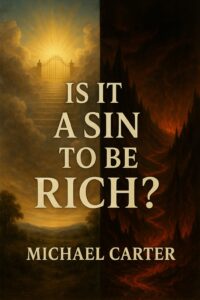
What This Book Dares to Ask
Is It a Sin to Be Rich? confronts a question people often avoid out loud but carry quietly for years:
can faith and wealth coexist without self-deception? Instead of offering a slogan or an easy verdict,
Michael Carter examines how money changes identity, relationships, humility, and moral reasoning.
In practice, the book asks sharper follow-ups: When does comfort become numbness? When does ambition become justification?
When does generosity become performance? Most importantly, what does wealth train a person to excuse?
Quick links:
About Michael Carter |
Faith, Wealth & Morality Insights |
Contact the Author
Why the Question Still Matters
Wealth is not only a personal issue. It is a social force. It shapes what people fear, what they tolerate, who gets believed,
and who gets blamed. Consequently, moral language gets distorted. The poor can be pressured into “humility” that looks like silence,
while the rich can be rewarded for “confidence” that looks like entitlement.
This book does not treat money as automatically evil or automatically virtuous. Instead, it treats money as a magnifier.
It magnifies motives, habits, and blind spots. Therefore, the central concern is not the number in an account; it is the person being formed by that number.
From the Pages of the Book
“We preach humility to the poor and ambition to the rich — and wonder why they never understand each other.”
“The altar has always had two sides: one for sacrifice, and one for gold.”
“Faith is not meant to starve the body — and wealth is not meant to starve the soul.”
What You’ll Explore in This Book
The book moves through the tension people feel but rarely name: the desire to build a stable life, the fear of losing it,
and the temptation to justify almost anything to protect comfort. Along the way, Carter examines how “success” can quietly rewire a conscience.
- Faith under pressure: what belief looks like when comfort arrives, not only when comfort disappears.
- Poverty and dignity: the difference between compassion and romanticizing suffering.
- Power and blindness: how influence changes the way a person hears truth and feedback.
- Generosity and motive: giving that heals vs. giving that purchases identity.
- Systems and incentives: why individual morality gets harder inside profit-driven structures.
Who This Book Is For
This is written for readers who want moral clarity without propaganda. It is also written for people who have achieved something
and felt an unexpected internal cost. In other words, it is not about shaming success; it is about examining what success trains.
- Readers wrestling with questions about faith and money
- Believers who wonder whether wealth is compatible with spiritual integrity
- Entrepreneurs and professionals questioning the cost of “winning”
- Anyone who wants to think clearly about conscience, status, and responsibility
How to Read It for Maximum Value
If you want this book to stay practical, read it slowly. After each section, pause and ask a direct question:
“What am I currently justifying?” That question is uncomfortable, but it is also clarifying.
Additionally, consider discussing it with someone who will tell you the truth rather than agree with you.
Discussion prompts you can use
- Where do I confuse comfort with safety?
- What do I defend automatically—and why?
- Do I treat people differently based on their usefulness?
- What would “enough” look like for me in practice?
- What kind of person is my lifestyle training me to become?
Related Reading on MichaelCarterBooks.com
If you want to explore how incentives and modern systems shape behavior, these pages connect well with the themes of this book:
- Faith, Wealth & Morality Insights
- The Fitness Trap (systems, incentives, and consumer behavior)
About the Author
Michael Carter writes with an emphasis on accountability and moral clarity. His work focuses on how incentives shape decisions,
how language can hide motives, and how conscience weakens when comfort becomes a final goal.
To learn more, visit About Michael Carter.
Note: This page is for informational and educational purposes and does not provide financial, legal, or pastoral counseling.