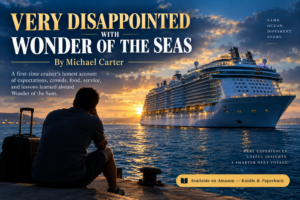
A first-time cruiser’s personal account of expectations, impressive
moments, crowded elevators, food, entertainment, customer service and
the lessons that came from sailing one of the largest cruise ships in
the world.
Very Disappointed With Wonder of the Seas by Michael Carter
tells the story of a carefully researched first cruise that did not unfold
the way the author expected. The book looks beyond promotional videos and
ship advertisements to describe what it actually felt like to live aboard
Royal Caribbean’s Wonder of the Seas for four nights. It covers the good,
the disappointing and the unexpected, from the Junior Suite and remarkable
ship design to crowded elevators, dining frustrations, entertainment,
customer service and the realities of moving thousands of people around a
modern mega-ship.
Buy Very Disappointed With Wonder of the Seas
The book is available directly from Amazon in both Kindle and paperback
editions. Select the format you prefer below.
On This Page
- Why This First Cruise Mattered
- Researching Wonder of the Seas
- The Impressive Side of the Ship
- Crowds and Elevators
- Windjammer and the Food Experience
- Entertainment and Expectations
- Customer Service
- Onboard Spending
- The YouTube Effect
- Who Should Read the Book?
- About Michael Carter
- Frequently Asked Questions
Why Very Disappointed With Wonder of the Seas Began With a First Cruise
There is something different about taking a first cruise. An experienced
cruiser already understands embarkation, dining schedules, port days,
elevators, entertainment reservations and the rhythm of a ship. A
first-time cruiser does not have those habits yet. Everything is being
judged against what was promised, what was researched and what the traveler
believed cruising would be.
Michael Carter deliberately selected a four-night cruise because four
nights seemed like a sensible test. It was long enough to experience the
ship, eat in different places, see entertainment, visit ports and
understand the basic rhythm of cruising. At the same time, it was not so
long that an unpleasant experience would turn into a lengthy vacation from
which there was no escape.
The decision was not spontaneous. The trip was researched extensively
before departure. Flights were considered. A hotel was booked for the
night before sailing so there would be less risk of a flight problem
causing a missed cruise. Passports, cruise documents, check-in procedures
and the Royal Caribbean application were studied. Restaurants, drink
packages, neighborhoods and entertainment were investigated before the
ship was ever seen in person.
That preparation is important to the story because disappointment requires
an expectation. The more a traveler studies a product, the more precise
that expectation becomes. Very Disappointed With Wonder of the Seas
is therefore not simply a collection of complaints. It is an examination
of what happens when a highly researched expectation meets the day-to-day
reality of a vacation.
Researching Wonder of the Seas Before Boarding
Cruise research today is completely different from what it was decades
ago. Travelers can watch hundreds of YouTube videos before spending a
dollar. They can see cabins, decks, restaurants, buffets, pools, shows,
shops and virtually every public space on a ship. For a first-time cruiser,
this amount of information creates confidence.
Before sailing, videos made Wonder of the Seas appear almost limitless.
The ship has numerous neighborhoods and public spaces. It has restaurants,
entertainment venues, outdoor areas, pools, shops and activities. Seeing
them one at a time on a screen can create the impression that something is
always available.
The actual passenger experience can be more complicated. A venue that
exists is not necessarily open when a passenger wants to use it. A space
that looks empty during a professionally filmed ship tour can look
completely different when thousands of passengers are aboard. A restaurant
may be included in the fare but operate during limited hours. An elevator
lobby that looks enormous in a video can become crowded when dinner,
entertainment and port traffic occur at the same time.
The book examines this difference because it can help future travelers ask
better questions. Instead of asking only, “How many restaurants are on the
ship?” a traveler may want to ask, “How many of those restaurants are
included, and when are they open?” Instead of asking how many elevators a
ship has, a traveler may want to know how those elevators perform during
peak demand.
The Impressive Side of Wonder of the Seas
The title Very Disappointed With Wonder of the Seas does not mean
that every part of the ship was disappointing. Some aspects were genuinely
impressive, and the book makes room for those observations.
The scale of Wonder of the Seas is difficult to appreciate until a person
stands aboard it. Different decks can have dramatically different
personalities. The ship contains areas that feel less like the interior of
a traditional vessel and more like parts of a resort. Its engineering,
architecture and sheer size deserve recognition.
The Junior Suite became another positive aspect of the trip. The larger
room and balcony created more personal space. Bathrobes, an espresso
machine and the upgraded bathroom made the cabin feel more comfortable.
After receiving the upgrade shortly before sailing, the cabin became one
of the parts of the vacation that came closer to the experience originally
imagined.
Even details as simple as the shower stood out. After staying at a
pre-cruise hotel where the water pressure had been disappointing, the
strong shower aboard the ship became unexpectedly memorable. Details such
as these matter because the book is intended to preserve the entire
experience rather than reshape every memory to fit a negative title.
A fair consumer account should be capable of holding two ideas at the same
time. Wonder of the Seas can be an engineering achievement while an
individual passenger can still leave disappointed. A cabin can be
excellent while crowd management is frustrating. A crew member can work
hard while another service interaction leaves a poor impression.
Crowds, Elevators and Moving Thousands of Passengers
Crowding became one of the most important subjects in the book. When
thousands of people share a vessel, the ability to move those people
efficiently becomes part of the vacation itself.
Elevators repeatedly affected the experience. At busy times there were
long waits, packed cars and many stops before reaching the desired deck.
Some elevator controls did not seem to respond as expected. At times,
certain elevators appeared to remain on floors rather than moving.
Whether the cause was traffic, maintenance, operating procedure or another
factor, the passenger experience was the same: getting from one area of
the ship to another could become frustrating.
This matters because the attraction of a mega-ship is the number of things
available to do. But every additional restaurant, venue, deck and
neighborhood creates another destination passengers must reach. If moving
between those destinations becomes difficult, the ship’s size changes from
an advantage into a tradeoff.
Experienced cruisers may learn which times are busiest or may use stairs
whenever possible. A first-time cruiser has not developed those
strategies. That perspective gives readers a useful look at what a
mega-ship can feel like without years of cruise experience to compensate
for congestion.
The Windjammer Buffet and the Food Experience
Food is a major part of cruise marketing. Images of overflowing buffets,
specialty restaurants and beautifully plated meals help sell the idea that
cruising provides almost unlimited choice.
The Windjammer buffet therefore became an important test of that
expectation. There were certainly many food items available, but variety
alone does not determine whether a dining experience feels generous or
enjoyable.
One incident involved waiting for ham to be carved. Rather than carving
enough to keep the line moving, small portions were being cut while people
waited. Eventually the frustration became strong enough that the plate was
left behind and the meal was abandoned.
Someone reading that story may consider it a minor inconvenience. That is
exactly why it belongs in the book. Vacation satisfaction is often shaped
by an accumulation of apparently small moments. One wait is insignificant.
Repeated waits, restrictions, closed venues and disappointing meals can
gradually change how a passenger feels about the entire vacation.
Availability also mattered. On a port day, venues such as Loco Fresh and
the Dog House were not always open at the time expected. On a ship
advertised around choice, encountering closed venues can make a massive
ship temporarily feel as though it has fewer options than its size
suggests.
Entertainment, Technology and Expectations
Wonder of the Seas is capable of elaborate entertainment. The theaters,
technical systems and production environments are far beyond what many
smaller ships could provide.
However, technical capability does not automatically produce an emotional
connection with an audience. During the cruise, some entertainment did not
meet the expectations created before sailing. Performers appeared across
multiple productions, and at one point video and live performance seemed
out of synchronization.
The response was personal. A show that one passenger finds disappointing
may be another passenger’s favorite part of the cruise. The book does not
present subjective reaction as universal fact. Instead, it records what
the entertainment felt like to the author during that particular sailing.
That distinction is important throughout Very Disappointed With Wonder
of the Seas. It is not an official inspection report. It is not a
claim that everyone aboard experienced the same thing. It is a firsthand
account, and readers can compare that account with positive reviews,
negative reviews and official information before making their own travel
decisions.
Customer Service Becomes Most Important When Something Goes Wrong
Customer service is easy to appreciate when everything is running
smoothly. The real test appears when a customer questions a charge,
reports a concern or asks someone to resolve a problem.
One example involved charges associated with soda cups. After the issue
was raised, a supervisor ultimately credited the disputed charges. The
resolution was positive, but the event reinforced a practical lesson:
passengers should review their onboard account rather than assume every
charge is correct.
Another concern developed around a lifeguard-related incident on Deck 16.
The process of reporting the concern through onboard personnel and Guest
Services became part of the story because a passenger’s confidence in a
company can depend heavily on how employees respond when a concern is
raised.
The purpose of describing those interactions is not to condemn thousands
of crew members because of individual moments. Cruise employees work long
hours while serving enormous numbers of passengers. The point is that
company culture is experienced one interaction at a time. A corporation
may have excellent policies, but passengers judge those policies through
the people they actually encounter.
The Real Cost of a Cruise Goes Beyond the Ticket
A cruise fare is only one component of cruise spending. Once aboard,
passengers can spend additional money on drinks, specialty restaurants,
casino play, photographs, excursions, shopping and premium experiences.
For many people, those extras are part of the fun.
Michael Carter went aboard prepared to spend additional money. But as the
trip progressed, disappointment changed that behavior. The desire to
purchase more drinks, food or optional experiences became weaker.
That relationship between satisfaction and spending is one of the broader
consumer themes in the book. People are more willing to spend when they
feel relaxed, valued and confident in the product. When irritation grows,
the wallet often closes.
Readers interested in Michael Carter’s broader writing about consumer
systems may also want to read
The Fitness Trap
,
which examines how business models and recurring payment systems can
influence customer behavior. The topic is different, but the underlying
interest in incentives and consumer experience is similar. :contentReference[oaicite:1]{index=1}
The YouTube Effect: What Cruise Videos Cannot Always Show
YouTube was an important part of the research before this voyage. Ship
tours can be extremely useful. They help travelers understand layouts,
cabins, restaurants, pools and entertainment areas before purchasing an
expensive vacation.
But video has limitations. A creator can film an area when it is empty.
A camera can choose the best angle. A restaurant can be shown at a quiet
time. A frequent cruiser may already understand unwritten routines that a
first-time passenger does not know.
This does not mean cruise creators are dishonest. It means that a video
and a vacation are different things. One is edited. The other is lived in
real time.
A prospective cruiser should therefore compare several kinds of sources:
official cruise-line information, professional reviews, repeat-cruiser
reviews, first-time cruiser accounts and critical reviews. Reading only
praise can create unrealistic expectations. Reading only complaints can
create the opposite problem.
For current official information about the vessel, readers can visit
Royal Caribbean’s official Wonder of the Seas page
.
Official information should then be compared with independent passenger
experiences.
Who Should Read Very Disappointed With Wonder of the Seas?
The book is especially relevant to people planning their first cruise.
Many first-time cruisers have the same questions Michael Carter had before
boarding. Will the ship feel crowded? Is the buffet as impressive as it
looks online? Are restaurants always open? Is a larger ship automatically
better? How easy is it to move between decks? What happens when a customer
has a problem?
It may also interest experienced cruisers because experienced travelers
sometimes forget what the industry looks like to someone encountering it
for the first time. Habits that seem obvious after twenty cruises may not
be obvious after zero.
The book is not written to tell readers that they should never sail Royal
Caribbean or never board Wonder of the Seas. Different travelers value
different things. Families may love the number of attractions. Some
passengers may enjoy the entertainment far more. Others may tolerate
crowds because they value having dozens of activities available.
The purpose is to add another perspective. A prospective passenger can
read this experience alongside glowing reviews and decide which details
matter personally.
It teaches you what kind of traveler you are, what matters to you, what
you are willing to overlook and what you are not.
About Michael Carter
Michael Carter writes about systems, responsibility, consumer behavior,
morality and the distance between what people are promised and what they
actually experience.
His books approach different subjects, but the underlying method remains
similar: examine the details, question assumptions and describe what is
often overlooked.
To learn more, visit the
About Michael Carter
page. The site’s current author page describes Carter’s work as focusing
on clarity, responsibility and practical questions rather than easy
conclusions. :contentReference[oaicite:2]{index=2}
Readers can also explore
Is It a Sin to Be Rich?
,
which examines wealth, morality and responsibility, or
Insanity Checked In, Humanity Checked Out
for another part of the Michael Carter Books catalog.
For articles and additional commentary, visit
Michael Carter’s Blog and Insights
.
Order the Book From Amazon
Read the complete story in Very Disappointed With Wonder of the
Seas by Michael Carter. Choose Kindle for digital reading or the
paperback edition for a printed copy.
Frequently Asked Questions
What is Very Disappointed With Wonder of the Seas about?
It is Michael Carter’s first-person account of his first cruise aboard
Royal Caribbean’s Wonder of the Seas. The book discusses the planning,
expectations, Junior Suite, dining, buffet, elevators, crowds,
entertainment, customer-service encounters and lessons that followed the
trip.
Is the book only negative about Wonder of the Seas?
No. The book describes positive features as well as frustrations. The
ship’s impressive size, design, cabin features and other enjoyable moments
are included because the objective is to describe the experience
accurately rather than pretend every moment was negative.
Is Michael Carter affiliated with Royal Caribbean?
No. Michael Carter Books is independent. The book represents the author’s
personal experience and opinions and is not sponsored, approved or
endorsed by Royal Caribbean.
Will every Wonder of the Seas passenger have the same experience?
No. Cruise experiences vary by sailing, passenger mix, weather, staffing,
itinerary, personal expectations and other conditions. The book documents
one first-time cruiser’s experience and allows readers to decide what
parts are relevant to their own travel plans.
Where can I purchase the Kindle edition?
The Kindle edition is available directly from Amazon at
Amazon Kindle — Very Disappointed With Wonder of the Seas
.
Where can I purchase the paperback?
The paperback edition is available directly from Amazon at
Amazon Paperback — Very Disappointed With Wonder of the Seas
.
How can I contact Michael Carter?
Reader feedback and book-related inquiries can be submitted through the
Contact Michael Carter
page. The contact page is already part of the Michael Carter Books website
and provides a direct path for reader and media inquiries. :contentReference[oaicite:3]{index=3}
Independent author statement:
Very Disappointed With Wonder of the Seas is an independent personal
account. Royal Caribbean International and Wonder of the Seas are
referenced because they are the cruise line and vessel discussed in the
book. Cruise schedules, restaurants, prices, policies, entertainment,
staffing, operating hours and onboard procedures can change. Travelers
should verify current information directly with Royal Caribbean before
booking.